




EU’s New PPWR Rules for Food Flexible Packaging: What Brand Owners Must Know
EU’s New PPWR Rules for Food Flexible Packaging: What Brand Owners Must Know
If you sell food products in the EU, your flexible packaging is facing the biggest regulatory shift in a decade.
The EU PPWR (EU 2025/40) starts full enforcement from August 12, 2026, with stricter deadlines through 2038.
Here’s what every food brand must know.
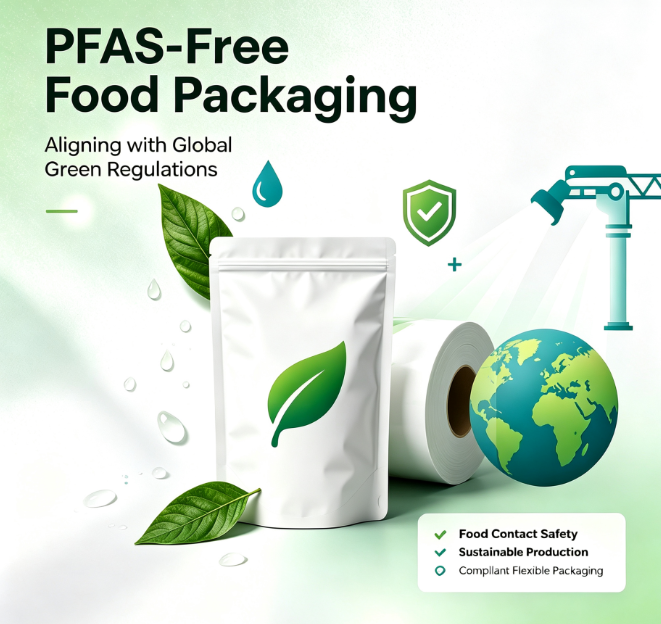
1. Harmful substances: PFAS & heavy metals banned
From 2026.8.12, food contact flexible packaging must comply with:
· Total F < 50 ppm for PFAS (non-polymer PFAS <25 ppb, sum <250 ppb)
· Heavy metals (Pb, Cd, Hg, Cr VI) < 100 mg/kg
· No more PFAS in oil/water resistant coatings, inks, or adhesives
👉 If your current food bags (bakery, snacks, fast food) contain PFAS, they cannot enter the EU after August 2026.
2. Material structure: multi-layer non-detachable composites are OUT
By 2030, any flexible packaging with recyclability <70% (Grade D) is banned.
By 2038, only Grade A (≥95%) and B (≥80%) are allowed.
Traditional structures like PET/AL/PE, PET/PA/PE, metallized films are no longer compliant.
✅ Compliant directions:
· MDO-PE / mono-PE (≥90% PE)
· Paper-based coated barrier
· Detachable laminates (PE + peelable PET/PA)
3. Mandatory recycled content (PCR) for food contact
From 2030:
· Food contact PE/PP flexible packaging: ≥10% post-consumer recycled (PCR)
· Food contact PET flexible packaging: ≥30% PCR (2040 ≥50%)
Challenge: food-grade PCR must comply with EU 10/2011 migration limits and be traceable (GRS/ISCC PLUS).
4. Recyclability grading & market access
From 2030: Grade D (<70% recyclability) = banned from EU market.
You need third-party certification like RecyClass or CEFLEX, based on real recycling streams, not lab theory.
Bottom line for food brands
Mono-PE/PP + no PFAS + food-grade PCR + recyclability ≥70% = your EU market entry ticket.
If your current flexible packaging doesn’t meet these, you have less than two years to redesign.